Paris · GeoNFC
The city wakes before dawn.
Beneath today’s bustle lies the voice of an old market.
Without a recording, we use a voice available on your device. Quality and availability depend on the browser.
The place’s story · free
Les Halles
This was once where Paris found its daily food. Imagine carts, crates and bargaining voices in place of today’s shop windows.
- 1969
- start of the move to Rungis
- Baltard
- architect of the iron pavilions
Read the full guide
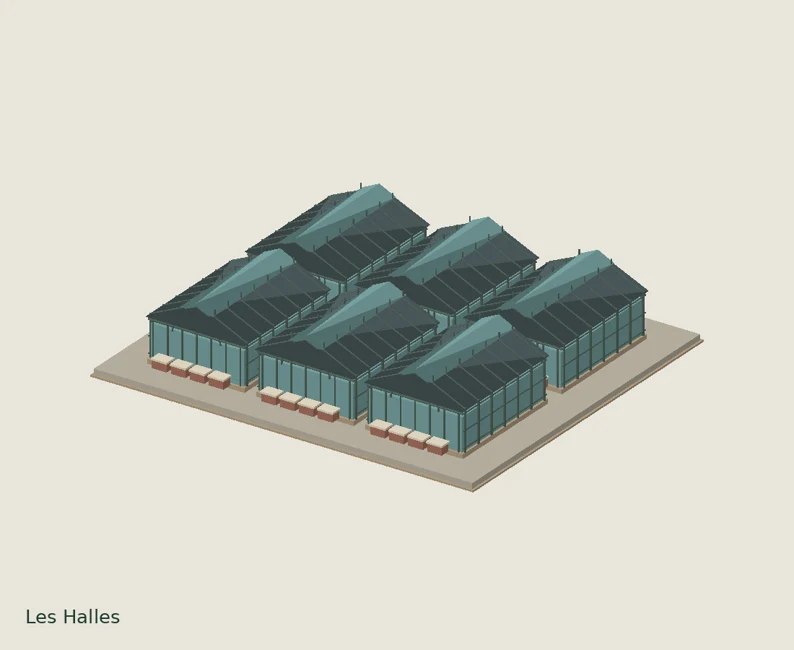
Stop for a moment and listen to the city. Today you may hear footsteps, conversations and traffic. At the old Les Halles, traders and deliveries would have joined that sound. The central market helped feed Paris. In the nineteenth century, architect Victor Baltard gave it a new form: iron and glass pavilions that let daylight inside. Eventually, large-scale deliveries and the growing city became difficult neighbours. In 1969 the move to Rungis began. The pavilions later disappeared and the district changed. Imagine this space as a place of everyday work, smells and encounters. A city’s history is not only the history of its palaces. It also begins with the people who brought its food each morning.
Historical source ↗3D · Les Halles
Explore the place in 3D
Stylised model with simplified proportions. Historical Les Halles and the Bastille are illustrative reconstructions.
Your code for this place
This code belongs to this passport. Use it at another stop to unlock both stories.
A stamp records a page visit; it does not by itself verify physical presence.
Atlas of Lost Voices
The last crate
The voices of the people who gave the city life are fading. Find their messages and restore the atlas. Five Paris stops form the main quest; Versailles is a bonus.